
Overview
d’Avignon is a classic French patisserie in Brookline, Massachusetts, known for its meticulously crafted pastries and refined in-store experience. At the time of this project, orders were accepted exclusively by phone, creating frustration for both customers and staff.
The project goal was to design a digital menu and ordering experience that would allow customers to browse offerings and place orders with confidence. Deliverables included digital wireframes for key screens, and an interactive prototype for the primary user flow. I served as the sole designer, responsible for all aspects of the research and design phases.
While d’Avignon is a hypothetical business created for Google’s UX Design Certificate program, the project is grounded in a realistic context, modeled after the operations and constraints of an independent, premium patisserie. This allows the design process to explore practical, real-world challenges while maintaining a controlled scope.
Problem
Phone ordering creates frustration for both customers and staff, especially when orders are large, complex, or time-sensitive. Customers lack an easy way to browse the full menu, review selections, or feel confident that their order is correct.
Objectives
Enable easy, confident user interactions, guided by an intuitive interface
Provide straightforward ordering framework to simplify complex orders
Optimize login, browsing, and checkout flows to provide an elegant and efficient user experience
Reflect the premium experience of visiting d’Avignon in person
Design Process
Research examined the behaviors and needs of customers during the ordering process. While primary research was not feasible, I conducted hypothetical user interviews using provided customer profiles and supplemented these insights with a competitive audit of existing local patisseries.
This process produced two user personas, and distilled users' shared behaviors, expectations, and pain points into a concise set of user insights:
Users want to save time without compromising a thoughtful, personal experience.
Users expect technology to remove frustrations subtly and reduce effort.
Aesthetic quality directly influences what users decide to order.
d’Avignon is perceived as a premium brand; the digital experience must feel refined and intentional.
From these insights, I derived four guiding principles which served as the foundation of the design ethos for the project, directly informing every design decision.
Design Principles & Key Decisions
Before sketching any wireframes, I created a flowchart to establish the app’s information architecture and navigation. This helped clarify which screens were essential and enabled me to focus the prototype on a meaningful end-to-end user flow. The flowchart became a polestar for design decisions, providing a clear framework for implementing the four core design principles derived from user research:
Minimize interaction tasks to ease cognitive load on users wherever possible.
Users consistently expressed a desire to move through the ordering process quickly and with minimal effort. To support this, the interface is designed to reduce unnecessary steps and interruptions wherever possible.
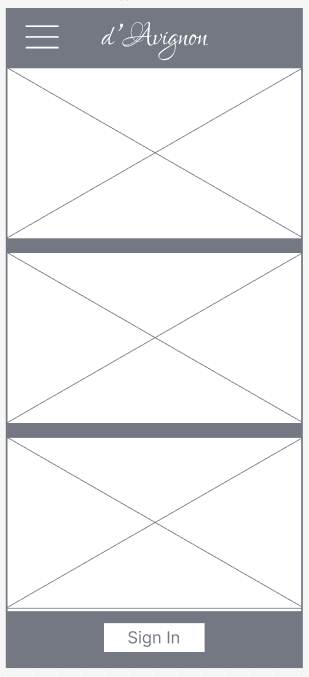
Primary actions such as login, menu access, and online ordering are surfaced directly on the homepage, allowing users with different goals to immediately begin their journey.
Constrain or expand user pathways strategically to support intuitive navigation
Rather than presenting all options at once, the app selectively narrows or broadens user pathways based on intent.
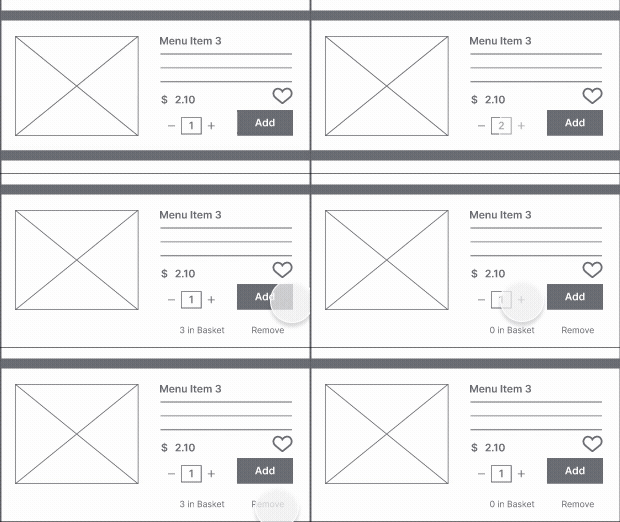
To reduce visual clutter and make long menu lists easier to navigate, the basket quantity indicator and “remove from basket” option are displayed only for menu items that have been added to the basket.
Pickup and delivery inputs are separated into distinct tabs, displayed one at a time to reduce visual clutter and prevent confusion between fulfillment methods.
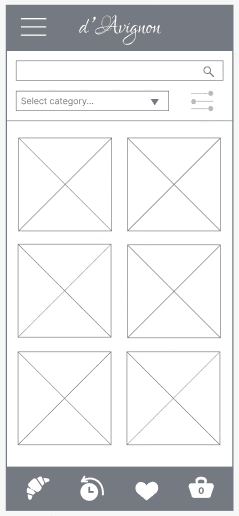
In contrast, the menu experience accommodates an array of ordering behaviors. Users who know exactly what they want can rely on search and filtering tools, while those who prefer to explore can browse by category. This approach balances flexibility with clarity, enabling efficient navigation without confusion.
Favor minimalist layouts to promote clarity and reinforce a premium brand perception
User research revealed that visuals strongly influence users’ purchasing decisions. To support this, the interface prioritizes product imagery by minimizing competing visual elements.
Layouts are structured to reduce clutter and maintain a clear hierarchy, ensuring that product photos remain the focal point without overwhelming users.
A homepage layout featuring three prominent hero images creates visual interest while maintaining clear space for primary actions, reinforcing a premium brand feel without compromising usability.
Align aesthetics and usability in every design decision
Throughout the project, visual design choices were made not only for their appearance, but for how effectively they communicate system status and support users' goals.
Interactive elements are designed to provide clear, immediate feedback while remaining unobtrusive, and visually cohesive with the overall interface.

Together, these decisions form a cohesive system that balances efficiency, exploration, and refinement. The result is an ordering experience that prioritizes clarity and confidence, while promoting speed and accuracy throughout the process.
Impact
The final design addresses the core goals of the project: enabling confident ordering, simplifying complex tasks, and optimizing key flows, while reflecting the refinement of the brand.
The end-to-end ordering flow allows users to browse, select, and review pastries efficiently, whether they are returning customers familiar with the menu, or first-time visitors exploring offerings. Navigation is clear and intuitive, with persistent basket feedback and direct menu interactions supporting seamless task completion.
Informal usability sessions with a small group of participants provided feedback that informed iterative refinements. Adjustments such as increasing text size and weight on key labels improved clarity, scannability, and the overall ease of interaction.
While the scope of this project was limited to low-fidelity designs, care was taken to design a sleek visual structure with elegant interactions and navigational flows, which provide a scaffold for a luxurious brand experience in higher-fidelity iterations.
Takeaways
Clear design principles reduce overdesign and improve decision-making
This project exemplifies the importance of developing a strong design ethos grounded in research to give direction and purpose during the design process. Early exploratory wireframes were dense and attempted to accommodate too many possibilities at once; while useful for exploration, they lacked focus. Establishing clear, explicit design principles enabled critical evaluation of which elements truly serve the user. Returning to these principles allowed the design to be simplified, features to be consolidated, and unnecessary elements to be removed; improving clarity without reducing functionality.
Constraints can increase the need for critical reflection
Working within a hypothetical, course-based context presented the challenge of avoiding unintentional bias. Without direct access to real users, personal assumptions could easily influence design decisions. Grounding choices in research artifacts and articulated principles throughout the project proved essential to keeping user needs at the heart of the design. This project strongly reinforced the universal UX principle that design decisions should be guided by evidence and clear criteria, embedding it into my design practice.
"Intuitive" behavior varies among users
Usability testing, though informal, led to meaningful improvements. Participants were able to complete the primary flow without assistance, but moments of hesitation revealed that intuitive behavior and interaction expectations can vary between users. Some users relied primarily on instinctual navigation, generally disregarding prompts or alerts. These observations led to iterative refinements to visual hierarchy and affordances to improve navigational clarity without altering the overall structure. This insight revealed by the usability testing reinforces the need to design for a range of interaction patterns, rather than a single assumed mental model.
Systems thinking strengthens the overall experience
Creating a flowchart at the outset was foundational to the project. Flowcharting forces careful evaluation of each interaction, reveals necessary steps that may not be immediately apparent, and helps define the scope of the work. Explicitly determining which paths are included and which are excluded prevents feature creep and keeps the focus on the core user experience. This approach strengthens the coherence of the user flows, and improves the overall experience.
This project reinforced my belief that strong, research-informed design principles are the cornerstone of effective UX. Elegant and purposeful design emerges through systems thinking and evidence-based decisions, leading to better outcomes for both users and designers.


|
Privacy Policy