
Overview
Stratton Greenhouses, a family-owned greenhouse in northwest Ohio, was facing the challenge of limited online visibility, which hindered potential customers from discovering their full range of products and services. I was tasked with conceiving, designing, and producing a dedicated website to promote the brand, provide easy access to information, and showcase the business’s diverse offerings. As the sole designer on the project, I was responsible for all aspects from concept through completion, creating a cohesive and engaging digital presence that made the business more accessible to customers.

Screenshot of website's homepage, showing the modular grid layout
Problem
The lack of a digital presence made it difficult for prospective customers to discover the greenhouse and explore its products and services.
Objectives
Increase visibility and reach through improved search engine presence
Clearly communicate the greenhouse’s value and competitive differentiators
Showcase specialty services that were frequently overlooked
Design Process
User Research
Traditional UX artifacts such as personas and journey maps were not created as part of the design process at the time, due to this project predating my formal UX training. The target audience profile was based primarily on stakeholder insight about the customer base. I have retroactively developed two Personas to exemplify the user needs taken into consideration when designing the website.


Constraints
Platform & Technical Constraints
Need for site maintenance by non-technical staff, necessitating straightforward design elements, and use of a drag-and-drop editor.
Layout and structure constrained by platform margins and responsive limitations, influencing content width, and modular design choices.
Limited ability to integrate with existing point-of-sale system, restricting advanced functionality and interactivity.
User Constraints
Significant portion of target audience consists of elderly users with varying levels of technical comfort.
Content & Resource Constraints
All photography, copywriting, and visual assets to be created in-house.
Time & Scope Constraints
Project focused on establishing a foundational digital presence rather than a fully custom or feature-rich experience.
Scope limited to essential informational pages and service discovery.
User research and usability testing opportunities limited by time and budget restrictions.
Brand Identity
By evaluating competitors and analyzing the greenhouse’s positioning within the local market, I identified the following core differentiators:
Family-run business: Customers value supporting local, family-owned companies.
Deep expertise: 75+ years in business, with long-term employees who have decades of experience.
Product quality: Greenhouse is both the grower and the retailer, ensuring proper plant care and quality throughout product lifespan.
Community involvement: Active participation in local sponsorships, donations, volunteer initiatives, and community beautification projects.

These attributes became the foundation of the website’s narrative and design identity.
Information Architecture
Referencing user research which identified a significant portion of the customer base as older adults with potentially lower technology comfort thresholds, the site’s content is structured for maximum clarity and accessibility.
A universal, persistent navigation menu allows users to access every page from any point, with all primary pages existing at the same hierarchical level. This flat structure ensures all products and services remain equally visible and easily discoverable, reducing cognitive load and eliminating deep and confusing navigation paths. Clear, descriptive labels and predictable navigation were prioritized to facilitate wayfinding throughout the website.
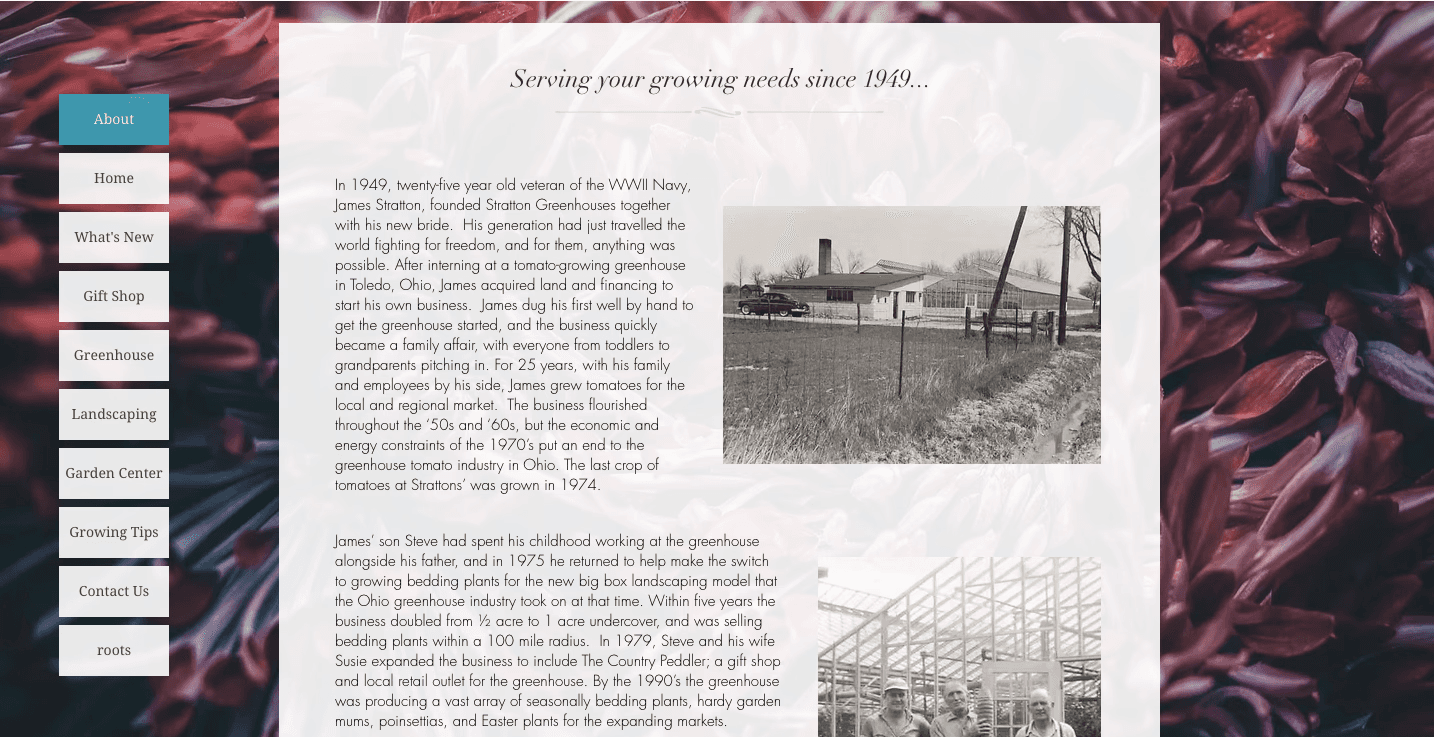
Screenshot of website's About page, showing the universal navigation menu, straightforward page structure, and strategic employment of vibrant color and imagery.
Layout & Visual Design
Considering the users' needs, the layout is designed to maximize clarity and usability, employing:
Clear, simple navigation
Prominent presentation of key services on the homepage
Content kept within the editor's responsive margins to ensure consistency across devices
These guidelines led to developing the homepage layout into a grid of square sections, which allows for multiple services to be featured equally while maintaining balance and responsiveness.
The greenhouse operates in a highly visual, sensory market. Visiting the website should feel as exciting and colorful as visiting the greenhouse itself. To embody this aesthetic, the design employs:
Bright, vibrant color palettes inspired by flowers and plants
Prominent use of real product photography to convey authenticity
Variation of background images and complementary color themes between pages
Consistent layout across pages to maintain clarity and visual order
To balance richness and usability, bold imagery is paired with predictable structure so users never feel overwhelmed.

Screenshot of website's Greenhouse page, showing continuity of design, and the use of authentic product photography and variable complementary color schemes.
Impact
Objective:
Increase visibility and reach through improved search engine presence
Impact:
The greenhouse website is now returned as the top result in a google search for greenhouses in Bluffton, Ohio, and among the top five results in searches for neighboring towns, without leveraging paid advertising or search engine optimization.
Visitors also actively engage with the site through actions such as signing up for the rewards program and newsletter. These interactions indicate that users are not merely browsing, but engaging meaningfully with the greenhouse’s offerings.
Objective:
Clearly communicate the greenhouse’s value and competitive differentiators
Impact:
Users can immediately understand and relate emotionally to the greenhouse’s distinguishing qualities, including its family-run history, longevity and expertise, and deep community involvement. The website highlights these aspects through both copy and imagery, reinforcing trust and authenticity while helping users connect with the business beyond its products and services.
Objective:
Showcase specialty services that frequently go overlooked
Impact:
Specialty services like container gardening and landscaping are prominently showcased, ensuring offerings that were previously overlooked are now highlighted. Services are clearly labeled and accessible from every page via a universal, persistent navigation menu, while a flat navigational hierarchy ensures that users can move freely and confidently throughout the website while exploring the business’s offerings.
Takeaways
If I were to approach it today, with my current knowledge of UX design methodology, I would employ more thorough user research, to better understand the needs of the user. While the website does successfully meet the user needs identified at the time, direct engagement with the end users could expose previously unidentified needs, and even unforeseen opportunities for the business itself.
I would incorporate wireframes and prototypes early in the design process to more thoroughly explore and validate layout options before committing to a final direction. I would also apply accessibility best practices to support compatibility with assistive technologies such as screen readers; awareness of which I did not have at the time, but have acquired through my formal UX training.
Finally, I would prioritize creating a more fixed and defined layout within the site editor, reducing the risk of unintended shifts during content updates. Clearly identifying editable content areas and further limiting the ability to modify structural elements would better support non-technical editors. This would make ongoing maintenance more reliable and easier to manage.
Overall, I am satisfied with the success of this project; I was able to achieve a good balance between stakeholder input, user needs, and aesthetic considerations to create a cohesive solution that effectively serves users while supporting the client’s goals.


|
Privacy Policy